Signal Words as Navigational Aids
Problem
You open a note and it takes you a moment to tell whether this is a settled definition, an open question, or a passing idea you jotted down half-asleep. The content alone doesn’t say what kind of thing it is.
Solution
Adopt a small, consistent vocabulary of signal words – words or short phrases you always use the same way – so the shape of a note announces itself. “Problem”, “Context”, “Solution” (as used throughout this pattern language) are signal words: seeing them tells you what to expect next, the same way they do in Orphanage or in Entry Points in a Zettelkasten Help Navigate Departments and Topics.
Some signal words work at the sentence level, too: “therefore”, “in contrast”, “as opposed to” mark the logical role a sentence plays, similar to how the wiki's note on coupling flags a definition with a blockquote.
See Entry Points in a Zettelkasten Help Navigate Departments and Topics#Related for how this pattern sits alongside titles and Maps of Content as another navigational aid.
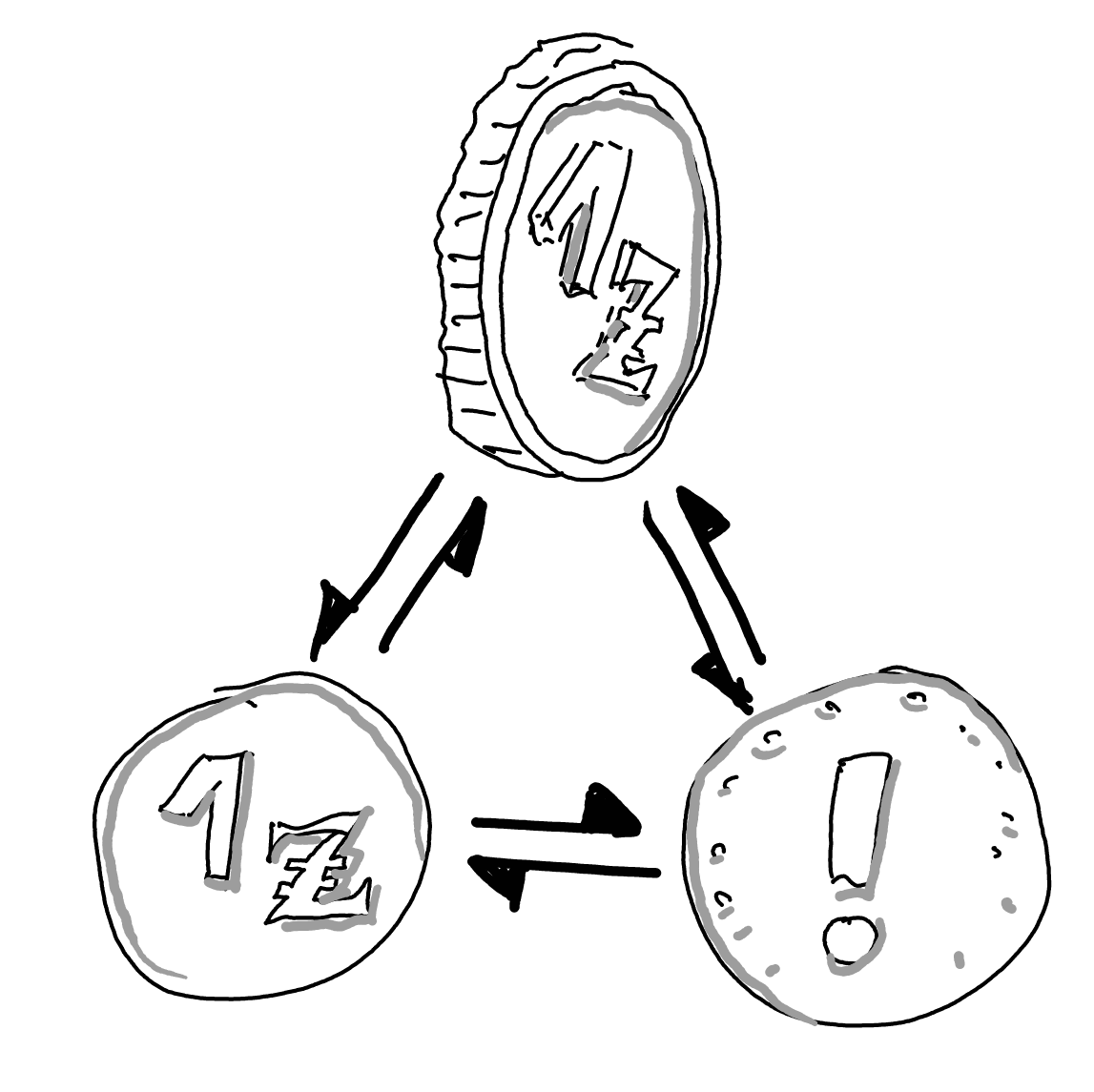
The coin-and-sides image below is an example of a note whose structure (whole, then two sides) is itself a kind of signal, independent of any words used:
Overdose
Too many signal words, or ones that overlap in meaning, stop signalling anything. If half your headings are called “Notes” or “Misc”, the word has stopped doing work.
Related
- This pairs with Capture the Coin and Its Two Sides as Three Notes, whose sections are themselves signalled by “top down” and “bottom up”.
- A page that hasn’t earned its signal words yet might belong in Windows in Your Zettelkasten instead – a pattern I haven’t written yet.